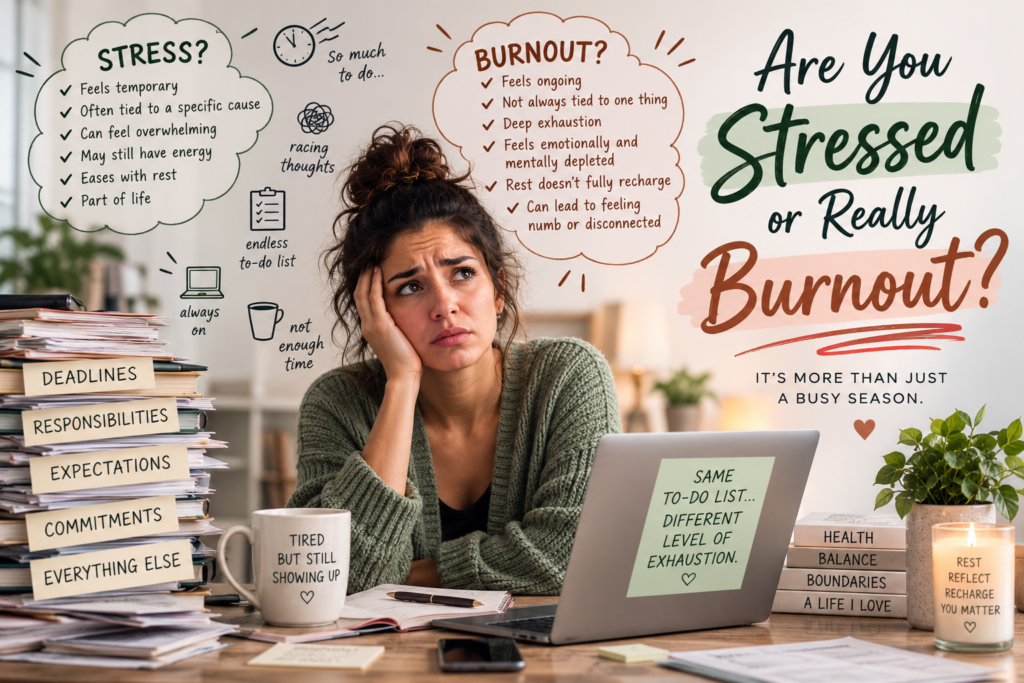
“I’m Tired…But What Kind of Tired?”
Our culture’s obsession with productivity and constantly being on the go can become more detrimental than beneficial, especially when our health and well-being start paying the price. I’ve seen this repeatedly in my work as a mental health therapist, and I see it now with my undergraduate students. There is always something else to do, another deadline approaching, another responsibility demanding attention. Everyone seems busy, but no one ever seems to quite catch up.
And then something interesting happens.
We finally get some downtime. We sleep in. We take the weekend off. We tell ourselves we’re going to rest.
But somehow, we still don’t feel restored.
We’re tired—but what kind of tired?
We may feel:
- Exhausted even after resting
- More irritable than usual
- Less motivated
- Disconnected from work, school, or responsibilities we normally care about
- Like even small things require too much energy
Are we just really stressed—or are we burned out?
We often use the words stress and burnout interchangeably, but they aren’t quite the same thing.
Stress and Burnout Are Related—but They Aren’t the Same
In my previous post, We Need to Talk About Stress, I talked about why so many of us feel chronically overwhelmed. But what happens when that stress doesn’t let up?
So, what exactly is burnout? The World Health Organization describes burnout as an occupational phenomenon resulting from chronic workplace stress that has not been successfully managed. It is characterized by exhaustion, growing mental distance or cynicism toward one’s work, and reduced professional effectiveness.
Although burnout has traditionally been discussed in the context of employment, similar patterns of chronic exhaustion and depletion are also studied in other demanding areas of life, including academics, caregiving, and parenting. In other words, when demands remain high for too long and the resources available to meet those demands remain too low, something eventually has to give.
(Tidbit: Did you know the phrase “burnout” was coined by psychologist Herbert Freudenberger in 1974. Freudenberger wrote the book Burnout, The High Cost of High Achievement after observing severe physical and mental exhaustion in healthcare and alternative clinic volunteers.)
Stress often feels like too much. Burnout can start to feel like not enough.
Stress can look or feel like:
- Too many demands
- Too much pressure
- Too much to think about
- Too much to accomplish
Burnout, on the other hand, feels like:
- Not enough energy
- Not enough motivation
- Not enough patience
- Not enough emotional capacity
- You have nothing left to give
When you’re stressed, you may still feel engaged, you just feel like there is too much coming at you.
With Burnout, there is a shift from overwhelmed to depleted.
What Burnout Can Look Like
Signs of Burnout include:
- Persistent exhaustion
- Emotional depletion
- Cynicism or detachment
- Decreased motivation
- Difficulty concentrating
- Feeling ineffective
- Losing enthusiasm for things you once cared about
- Withdrawing from people or responsibilities
- As it pertains to career/work, feeling incompetent and with low self-efficacy
- Rest not feeling particularly restorative
Key distinction:
Stress says: “I have too much to do.”
Burnout says: “I don’t know if I have anything left to give.”
How Stress Can Become Burnout
Burnout doesn’t usually happen because of one difficult day, week, deadline, or stressful event. It develops when the demands remain high while opportunities for recovery, support, autonomy, rest, or replenishment remain too low. Everyone’s threshold for living with burnout varies, and sometimes I am in awe by how long someone can go with their personal battery being on low. Some people can function this way for a surprisingly long time—but functioning isn’t the same thing as functioning well. Eventually, chronic depletion tends to show up somewhere—in our energy, mood, relationships, motivation, health, or ability to perform.
CHRONIC DEMANDS → DEPLETED RESOURCES → BURNOUT
How does stress lead to burnout?
Possible examples include:
- Constant deadlines without recovery time
- Taking care of everyone else while neglecting yourself
- Working through evenings and weekends
- Never mentally “clocking out”
- Feeling unable to say no
- High responsibility with little support
- Continually postponing rest until “things calm down”
What happens when things never actually calm down?
Why High Achievers May Miss the Signs
As it relates specifically to high achievers, burnout can look very different than not being able to handle stress.
High achievers are often good at functioning while depleted.
To them, burnout doesn’t always look like falling apart.
Sometimes it looks like:
- Still meeting deadlines
- Still showing up
- Still taking care of everyone
- Still answering emails
- Still getting things done
But internally, you may be running on fumes. High performers often tie their self-worth to achievement, leading them to ignore personal needs and limits, which causes deep emotional and physical exhaustion. There are 4 core drivers of high-achiever burnout. These are:
- Perfectionism: An intense fear of making mistakes or failing drives a continuous, unhealthy cycle of overwork.
- Masking: High achievers excel at projecting confidence, meaning their distress and exhaustion remain invisible until a major breakdown occurs.
- Poor Boundaries: Struggling to say no or delegate tasks leaves the stress response running constantly in the background.
- Identity Fusion: Many individuals over-identify their personal worth with their productivity and job output.
The same qualities that help us succeed—persistence, responsibility, high standards, and determination—can sometimes make it harder to recognize when pushing harder is no longer helping.
A Quick Check-In: Stressed or Moving Toward Burnout?
So how do you know if you’re really stressed out, or maybe heading towards burnout? Ask yourself the following:
- Does rest still help me feel better?
- Do I still feel connected to what I’m doing?
- Am I overwhelmed—or emotionally depleted?
- Have I become more cynical or detached?
- Do things I normally care about feel like obligations?
- Am I functioning mostly because I feel like I have to?
- Do I keep telling myself I’ll rest “later”?
- How long have I been feeling this way?
- How is feeling this way impacting my mood, relationships, and overall functioning?
You don’t need to wait until you completely fall apart before taking your exhaustion seriously.
If You’re Burned Out, “Trying Harder” May Not Be the Answer
Instead of only asking:
“How can I manage everything better?”
Consider asking:
- What is draining me right now?
- What actually restores me?
- What can I reduce, delegate, postpone, or let go?
- Where do I need better boundaries?
- Where do I need support?
- Am I giving myself genuine recovery time—or just enough rest to keep going?
- Is feeling this way really worth it?
- What will happen if I don’t do anything and continue feeling and performing on empty?
Recovery isn’t about becoming better at tolerating an unsustainable situation
There is a difference between recovery and maintenance. Sometimes what we call “rest” is really just enough downtime to make ourselves functional enough to return to the same unsustainable pattern. Something about the demands, resources, expectations, boundaries, or support needs to change.
Is This Sustainable?
We spend a lot of time asking ourselves:
Can I handle this?
And if you’re capable, driven, and accustomed to getting things done, the answer may continue to be yes.
However, just because you can, doesn’t mean you should.
But perhaps there’s another question worth asking:
“Can I keep living this way without sacrificing my well-being?”
Or even more simply:
“Is this sustainable?”
Success shouldn’t require you to continually run yourself to the ground. Preventing burnout doesn’t mean giving up your ambition. It means learning to pursue that ambition in a way that leaves room for your health, relationships, energy, and humanity.
Because the goal isn’t simply to see how much you can handle.
The goal is to build a life you don’t have to burn yourself out to maintain.

🌿 Is This Sustainable? Take a Closer Look.
If this post left you wondering whether you’re simply going through a stressful season—or whether you may be moving toward burnout, I’ve created a free Burnout Self-Assessment to help you take a closer look.
Use it as an opportunity to pause and reflect on your energy, emotional exhaustion, motivation, and overall well-being.
→ Download the Free Burnout Self-Assessment
This isn’t about giving yourself another label. It’s about noticing what you need before running on empty becomes your normal.
References
Bianchi, R., & Schonfeld, I.S. (2023). Examining the evidence base for burnout. Bulletin of The World Health Organization, 101 (11), 743-745.
Orosz, A. et al., (2016). A biological perspective on differences and similarities between burnout and depression. Neuroscience and Behavioral Reviews, 73, p. 112-122.