As I was getting ready to write this blog, I happened to see a short Instagram reel from Jannese Torres, host of the podcast Yo Quiero Dinero, which focuses on financial literacy for the modern Latina. I love her podcast, and eventually I’ll do a post on financial wellness. In her reel, she was crying and basically talking about how being the oldest in her family, the first one to “make it” and the one others depend and rely on is taxing and exhausting. I felt the emotion in her voice and could 100% relate. Her admitting this out loud was confirmation for me that this post could not come at a better time.
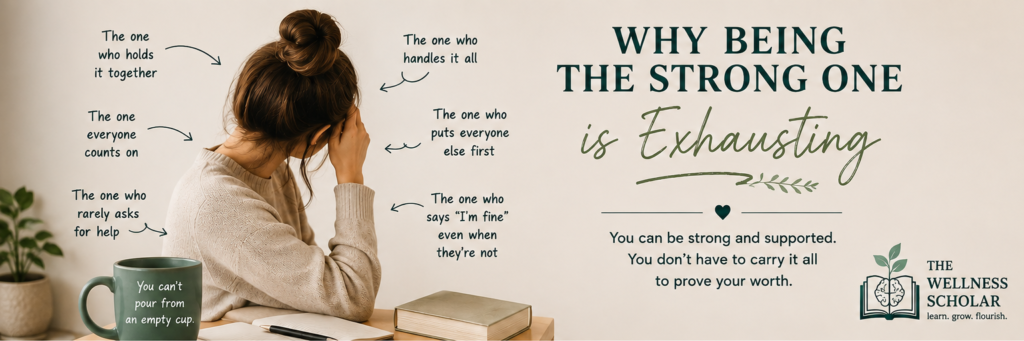
Maybe you’re the person everyone calls when something goes wrong. You listen. You problem-solve. You show up. You keep it together. Or maybe you’ve been deemed the “responsible one” in your family—the one who doesn’t get in trouble, pays the bills on time, and rarely asks for help.
At first, it may feel good to be seen this way. Being dependable becomes part of your identity. But eventually, that role can become a double-edged sword. When you’ve learned to be the person everyone else relies on, it can become surprisingly difficult to admit when you need support.
Who takes care of the strong and responsible one?
How Do We Become “The Strong One” or “The Responsible One”?
Some of us learn early on that being capable, independent, responsible, or emotionally composed earns praise. While others become the strong/responsible one because their family, workplace, friendships, or circumstances require it. In some cultures, birth order dictates the role you’re given in your home. If you’re the oldest, and female, that often comes with a set of expectations and responsibilities that other siblings don’t get. For me, as a first-generation Latina, there was the added pressure that my parents sacrificed so much and left their native country so that my siblings and I could have better opportunities. I think that’s part of the reason I was a high achiever and was driven about succeeding and “making it.” I will say that in my case, my parents never put this pressure on me. I put it on myself. That’s not always the case for those who felt pressured by their family to “make it”.
For highly achieving or driven people specifically, competence can become part of our identity:
“I can handle it” → “I should handle it” → “I have to handle it”
When Strength and Responsibility Become a Role You Can’t Put Down
There’s nothing wrong with being strong, responsible, or dependable. The problem comes when you begin believing you aren’t allowed to be anything else. Somewhere along the way, we internalized praise, comments, and messages from others and society about what it means to be the strong/responsible one. Our belief system changes to one where we struggle with:
- Difficulty asking for help
- Feeling guilty saying no
- Hiding struggles
- Taking responsibility for everyone
- Feeling uncomfortable receiving care
- Believing vulnerability equals weakness
- Feeling like things will fall apart if you stop
- If I say no, I’m being selfish
- Other people have it worse
- It’ll be easier if I just do it myself
- Afraid of disappointing others
- I should be able to handle this
Many of these beliefs tie into being a people-pleaser, which often leads to us sacrificing our needs and comfort for the sake of others. For others, we believe we are the only ones that can do something the “right” or correct way. This can lead to perfectionism tendencies where we don’t allow anyone else to step in and help. As a result, we give ourselves more work and tasks to do. The strong/responsible one may also struggle with setting appropriate boundaries, not always feeling that they’re allowed to say no or protect their time and energy.
Strength becomes exhausting when it stops being something you have and becomes something you believe you must perform.
What Being “Strong” or “Responsible” Can Cost You
Being the strong/responsible one isn’t only about doing more. It’s also about carrying more. Remembering. Anticipating. Planning. Checking in. Solving. Worrying. Managing other people’s needs while quietly managing our own. All of this becomes mentally heavy for us to carry. If we neglect to take care of ourselves, this ongoing mental and emotional load can contribute to feeling stressed out (If you haven’t yet, check out blog post #2 titled We Need to Talk About Stress).
When we continue to perform as the strong/responsible one, our overall wellness takes a big hit. Along with stress, we may feel or struggle with:
- Emotional exhaustion
- Headaches or other physical symptoms
- Resentment or Anger
- Difficulty relaxing
- Changes in Mood
- Disconnection from our own needs
- Relationship imbalance
- Burnout
Resentment and anger aren’t telling you that you’re a bad person. They’re telling you that you’ve been giving more than you have available to give.
Redefining What Strength and Responsibility Actually Look Like
It’s time to change how we define being the strong/responsible one. For too long we have let others define this for us. We allowed the script of: “I’m the responsible one so I should….” or “I’m the strong one, so I have to….” The good news is that we are allowed to change these scripts to ones that serve us better and don’t sacrifice our well-being in the process.
| Unsustainable Strength | Sustainable Strength |
| I can handle everything myself | I can voice when I need support |
| I can’t let anyone down | I recognize that my needs matter |
| I have to push through | I allow myself to rest when I need it |
| People will be disappointed | I can’t please everyone and that’s okay |
Being strong means showing vulnerability. It means knowing when we’ve reached our limit, when our cup is almost full. There is strength in being vulnerable. We have a right to express our needs and to say no. Vulnerability and strength are not opposites. They can co-exist and should definitely be part of our definition of the “strong one” and “responsible one”.
How to Stop Carrying Everything
Ok, so how long does it take to change our definitions of being the strong or responsible one? Honestly, there is no time frame. It can take weeks, months, even years, especially if we’ve been carrying these narratives since childhood or adolescence. However, like I tell my students and clients, we are all a work in progress. The first step is raising our awareness and recognizing when these roles are beginning to take a toll on our health and well-being. Now that your awareness has been raised, here are some small steps you can take to begin the shift:
- Notice what you’re carrying.
- Question whether it actually belongs to you.
- Practice asking for help before you’re desperate.
- Set one small boundary.
- Give yourself permission to have needs.
You may want to keep a journal and track your progress. Remember that there will be good days and not so good days. The goal is not perfection, it’s not to change in one week. It’s going to feel weird and uncomfortable saying no, creating a boundary, asking for help. These are things you’re not used to asking or doing. That’s ok! Sit with this discomfort. Journal about it. But don’t let that stop you from continuing to make these changes. The more you do them, the less weird it will feel. If you have a setback that’s okay! Reflect on it, see what you can do differently next time. Be kind to yourself. Believe in yourself. Believe that you deserve your space and that your needs matter. Remember that you owe it to yourself and to no one else. I see you and I feel you. You got this!
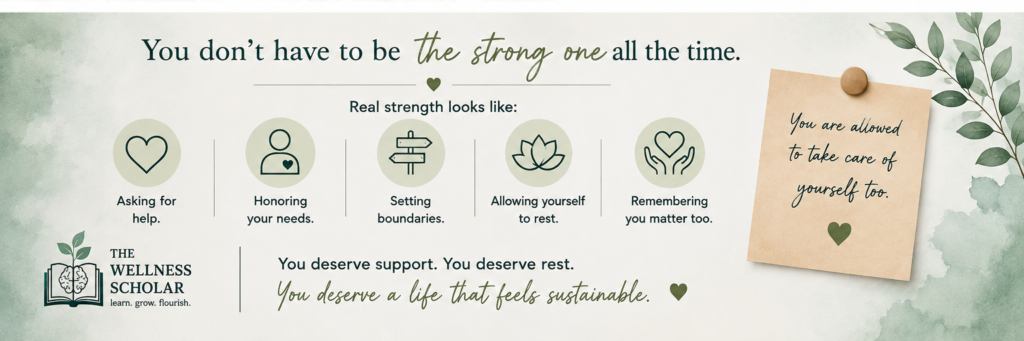
You don’t have to stop being strong. You just don’t have to be strong all the time.
Maybe real strength isn’t proving how much you can carry. Maybe it’s knowing when something has become too heavy to carry alone.
Reflection: Who Are You When You Don’t Have to Be the Strong One?
What would change if you believed you didn’t have to earn your worth by how much you could carry?
Need Help Putting Some of It Down?
If this post felt a little too familiar, try The 10-Minute “Put It Down” Reset. It’s a simple reflection designed to help you identify what you’re carrying, what isn’t yours to carry, what can wait, and where you might ask for support.
→ Try the 10-Minute “Put It Down” Reset