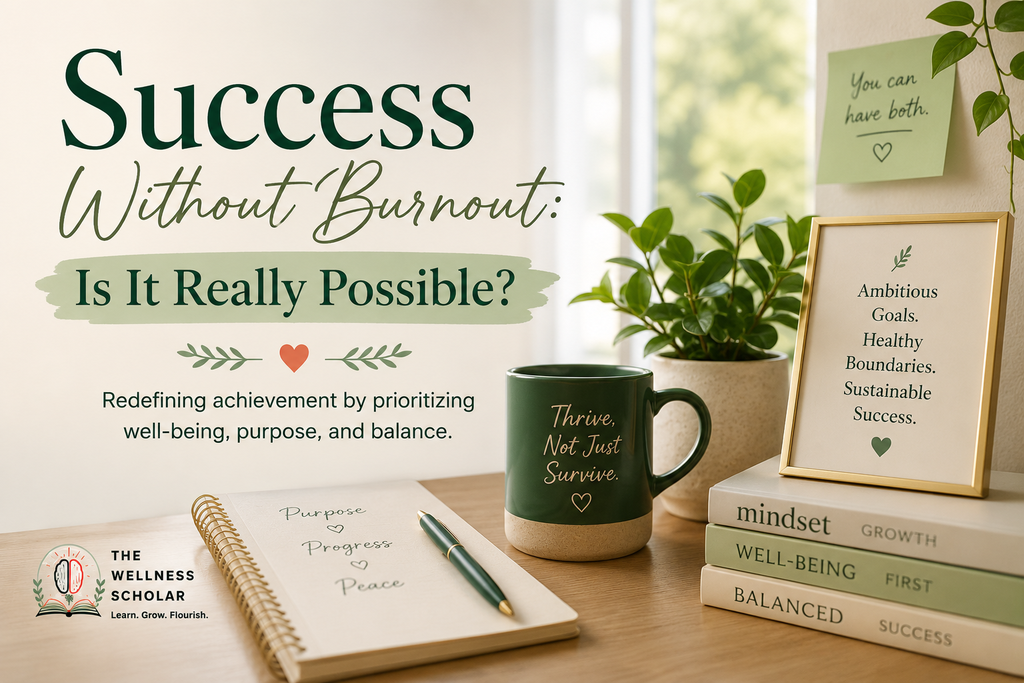
The Success Story We Were Sold
How many of us have heard the following:
“Work hard”
“Push through”
“Go above and beyond”
“Sleep is for the weak”
“Suck it up”
“Don’t quit”
“No pain, no gain”
“You’ll sleep when you’re dead”
Our society has made us believe that in order to “make it” or be successful, we must always be doing and achieving. Even when we’re tired or ill, we can’t stop or we’ll fall behind. Unfortunately, somewhere along the way, many of us started treating exhaustion as proof that we’re working hard enough.
Can we be successful without being chronically stressed, overwhelmed, and exhausted—or is burnout simply the price we pay for ambition?
I think we can be ambitious and achieve without burning out in the process.
When Did Exhaustion Become a Status Symbol?
In a society where our value can sometimes feel tied to our productivity, many of us fall prey to what is known as hustle culture. What exactly is hustle culture? It’s a belief system that glorifies constant work, long hours, and non-stop productivity as the ultimate path to success. It often rests on the assumption that working harder and longer will inevitably produce better results. The characteristics of hustle culture include believing that:
- Being busy = being important
- Productivity = worth
- Rest is “unproductive”
- Taking time off = feeling guilt
- Being constantly available is rewarded
- “I’m so busy” = a badge of honor
We’ve become very good at celebrating achievement without asking what it cost the person to achieve it.
What if success isn’t only about what you accomplish—but also about what it costs you to accomplish it?
The High-Achiever Trap
I don’t want to come off as being anti-success or against hard work. As someone who has had up to four jobs at the same time (on-call or contract positions for some of them), I subscribe to the high-achieving mindset. We all want to be successful in our professional and personal lives. What that looks like may vary, but the qualities that contribute to success tend to be the same:
Responsibility. Persistence. Discipline. High Standards. Reliability. Ambition.
None of these are inherently problematic.
The trouble begins when they become:
Responsibility → over-responsibility
Persistence → inability to stop
High standards → perfectionism
Reliability → always being available
Ambition → never feeling satisfied
Sometimes our greatest strengths become liabilities when we don’t know when to turn them off.
“I’ll Rest When…”
Does this sound familiar:
I’ll rest when this semester is over.
I’ll slow down after this project.
I’ll take care of myself once things settle down.
I’ll take a vacation when I get caught up.
But what happens when there is always something next?
For us high achievers, we may treat recovery as something we have to earn rather than something necessary to sustain performance and well-being. As my yoga teacher Jackie says during shavasana, rest is a birthright —–not something you earn.
What Does Sustainable Success Actually Look Like?
So, what is the answer? How can we continue to be ambitious, driven, and high achieving without feeling like we must sacrifice our rest and well-being? The answer is focusing on sustainable success as achievement that doesn’t require continually sacrificing your physical, emotional, and psychological well-being. Uusiautti and Hyvärinen (2021) describe sustainable success in terms of positive development, flourishing, well-being, and high performance. Here are some examples of how this can look:
| Traditional Success | Sustainable Success |
| How much can I accomplish? | What can I accomplish sustainably? |
| Push through | Know when to pause |
| Rest after everything is done | Build recovery into the process |
| Say yes to opportunities | Be selective about opportunities |
| Do it all yourself | Ask for help/delegate |
| More is better | Enough can be enough |
| Protect productivity | Protect energy too |
| Success at any cost | Success without losing yourself |
Rest Isn’t the Opposite of Productivity– The 42% Rule
In order to have sustainable success, we have to include rest and not compromise or sacrifice it. Recovery is part of performance, not something separate from it. In Burnout: The Secret to Unlocking the Stress Cycle, Emily and Amelia Nagoski introduce what they call the “42% rule”—the idea that roughly 42% of our time should be devoted to sleep, rest, connection, play, and other forms of recovery. The authors do not present 42% as a precise scientific threshold; rather, it illustrates a larger point: recovery isn’t an optional reward we earn after we’ve finished everything else. That 42% works out to roughly 10 hours a day devoted to sleep, rest, connection, play, and other forms of recovery.
Rest isn’t what you do after the work is finished. Rest is part of what allows you to keep doing meaningful work.
Boundaries Protect What Matters
In order to achieve sustainable success, it’s important to protect our resources. This will require us to know when to:
- Say no
- Not respond immediately to emails or text messages
- Protect non-work time
- Delegate to others
- Ask for help
- Let “good enough” actually be good enough
- Choose which opportunities deserve your energy
Every yes costs something—time, attention, energy, or opportunity. The question isn’t simply “Can I do this?” It’s also “Is this where I want my limited resources to go?”
Maybe the Goal Isn’t Balance
In The 80/80 Marriage, Nate and Kaley Klemp challenge the idea that healthy relationships always require a perfectly equal 50/50 split. I think a similar idea can be applied to work-life balance. Life isn’t always going to be perfectly balanced. There will be busy seasons. There will be deadlines. There will be periods when one area of our life requires more from us. That’s to be expected and it’s okay.
The goal isn’t perfect balance. The goal is to notice when temporary imbalance has become your permanent way of living.
Redefining Success
What does success mean to you now?
Not what your family says.
Not what society or social media say.
Not what your profession says.
Not what your résumé says.
Reflect and ask yourself the following questions:
- What am I working so hard toward?
- What am I sacrificing to get there?
- Is the trade-off worth it?
- What would “enough” look like?
- What do I want my life to feel like—not just look like?
- If I achieve my goal but lose my health, relationships, peace, or sense of self along the way, will it still feel like success?
Author and Entrepreneur Ramit Sethi talks about living your rich life, which is his philosophy for defining wealth by what you value the most. I think we can use this as a litmus test for picking and choosing what we will exert our energy and focus on.
Yes, Success Without Burnout Is Possible!
You don’t need to abandon ambition.
You don’t need to stop setting goals.
You don’t need to become less driven.
But you may need to stop using exhaustion as the measure of how hard you’re trying.
Maybe sustainable success isn’t about doing less with your life. Maybe it’s about building a life in which you can continue learning, growing, achieving, connecting, resting—and flourishing—for the long haul.
You can want success and protect your well-being. You deserve both.

Ready to take a break—but not sure what to actually do?
I’ve created a free 50 Ways to Take a Break guide with simple ideas you can use throughout your day to pause, reset, and recharge.
Because taking a break isn’t falling behind. Sometimes, it’s exactly what helps you keep going.
References:
Uusiautti, S., & Hyvärinen, S. (2021). Defining the new concept of sustainable success – A state-of-the-art analysis on the phenomenon.
New Ideas in Psychology, 60. 1-7.